
Discover why Vasant Kunj stays a preferred South Delhi residential hub — connectivity, green cover, schools, lifestyle, and property trends explained.
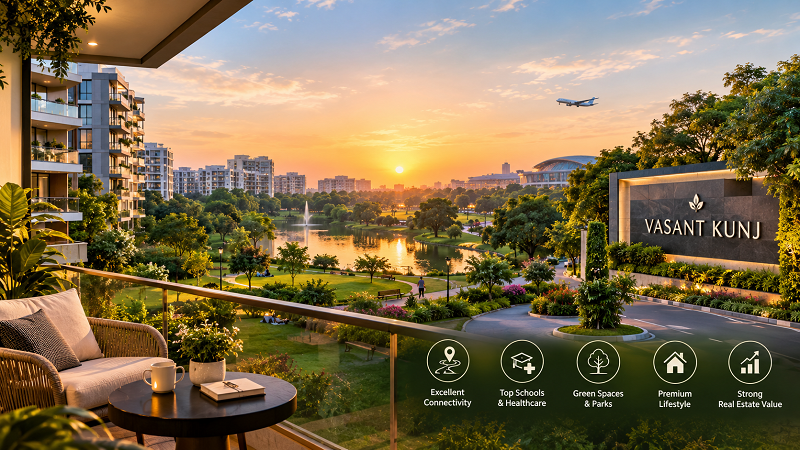
Vasant Kunj is one of South Delhi's most established residential neighbourhoods, and it has held that position for decades. Spread across several well-planned sectors, it sits close to the Delhi Ring Road, IGI Airport, and the Aravalli green belt, giving it a mix of urban convenience and natural surroundings that is hard to find elsewhere in the capital.
What keeps Vasant Kunj relevant even as newer micro-markets emerge across Delhi NCR is a combination of planning, greenery, and social infrastructure that has matured over time. Families who move here for schools or hospitals often end up staying for the quieter streets and easy airport access, while professionals renting nearby appreciate the shorter commute compared to areas further from the city centre. For anyone comparing options, it helps to see how a place like Vasant Kunj stacks up against upcoming pockets such as Flats for Rent in Vasant Kunj, where inventory and rental patterns reflect this long-standing demand.
This article looks at what actually makes Vasant Kunj work as a place to live — its layout, connectivity, amenities, challenges, and how it compares with nearby localities — so that buyers, tenants, and investors can make an informed decision.

Ut enim ad minim veniam, quis nostrud exercitation ullamco laboris nisi ut aliquip ex ea commodo consequat.
more
Ut enim ad minim veniam, quis nostrud exercitation ullamco laboris nisi ut aliquip ex ea commodo consequat.
more
Ut enim ad minim veniam, quis nostrud exercitation ullamco laboris nisi ut aliquip ex ea commodo consequat.
moreVasant Kunj is a planned South Delhi residential area developed by the DDA, known for wide roads and green cover.
It offers strong connectivity to IGI Airport, Gurugram, and South Delhi's commercial hubs via the Ring Road and NH-48.
The area has established schools, hospitals, and malls, making it attractive for families and working professionals.
Property and rental rates are higher than in many outer Delhi localities but reflect the location's stability and infrastructure.
Limited new construction and heritage-style layouts mean supply stays tight, which supports steady demand.
Vasant Kunj is a DDA-developed colony split into multiple sectors (A, B, C, and D), each with its own mix of independent floors, group housing societies, and DDA flats. Unlike some newer NCR developments that grew around a single commercial anchor, Vasant Kunj was planned with residential zoning as the priority, which is why the internal roads stay relatively low on traffic despite the area's popularity.
The locality borders the Asola Bhatti Wildlife Sanctuary and the Aravalli biodiversity park, giving several sectors direct access to green cover that most South Delhi neighbourhoods do not have. This is a recurring reason residents cite when asked why they chose Vasant Kunj over comparable areas like Vasant Vihar or Saket.
Vasant Kunj's location just off NH-48 and close to IGI Airport is one of its biggest draws for frequent flyers, airline staff, and corporate employees who travel often. The Ring Road connects it to Dhaula Kuan, Vasant Vihar, and further into South and Central Delhi within a reasonable drive.
Because Vasant Kunj sits on the Delhi–Gurugram corridor, commuting to Cyber City or Udyog Vihar takes less time than from many other South Delhi pockets. This has made it popular with professionals working in Gurugram's IT and corporate offices who still prefer living within Delhi.
While Vasant Kunj itself is not directly on a metro line, it is served by DTC and cluster bus routes connecting to the nearest metro stations, and app-based cabs are widely used given the area's proximity to the airport. Residents who need metro access typically use the Vasant Vihar or Chhatarpur stations, both a short drive away — an area also worth checking if you're exploring options to rent in Chhatarpur for comparison.
Direct answer: Vasant Kunj has a dense cluster of reputed schools, multi-specialty hospitals, and shopping centres within a 2–5 km radius, which is a core reason families choose to settle here long-term.
The area is home to well-known institutions such as Vasant Valley School and several other CBSE-affiliated schools, reducing the need for long school commutes — a major factor for families with young children.
Fortis Hospital Vasant Kunj and other nursing homes and clinics in the vicinity mean residents have quick access to emergency and specialist care, which matters for elderly residents and young families.
Vasant Kunj houses two large mall complexes — commonly referred to as Ambience Mall and DLF Promenade/Emporio — along with local markets for daily groceries. This mix of organised retail and neighbourhood shops keeps most day-to-day needs within walking or short driving distance.
Vasant Kunj's proximity to the Aravalli ridge gives it noticeably better air circulation and more tree cover than several other Delhi localities. Many sectors have internal parks, and residents often mention morning walks and weekend visits to the biodiversity park as part of why the area feels less congested than its commercial neighbours.
This green buffer also has a practical benefit: it has limited large-scale commercial construction, which keeps population density lower compared to mixed-use areas nearby.
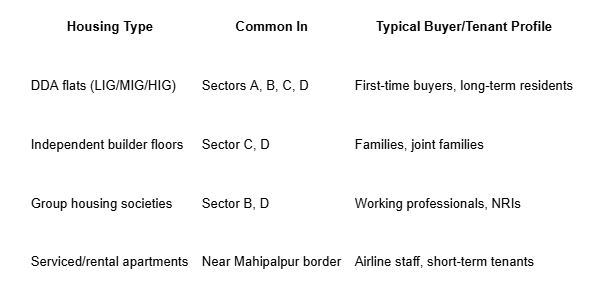
This variety means Vasant Kunj caters to different budgets and needs, from modest DDA flats to premium independent floors, unlike single-format developments that only suit one type of buyer. Tenants who find Vasant Kunj's rents on the higher side often widen their search to nearby South Delhi pockets, such as the Rental Homes in Paryavaran Complex, which offer a similar green, low-density feel at comparatively lower rents.
Short distance to IGI Airport, ideal for frequent travellers and airline employees
Strong social infrastructure: schools, hospitals, and malls within close range
Green surroundings from the Aravalli belt and biodiversity park
Lower traffic density on internal roads compared to commercial-heavy localities
Good resale and rental demand due to established reputation.
Property and rental prices are higher than several outer Delhi and NCR localities
Limited direct metro connectivity within the colony itself
Older DDA buildings may need renovation or maintenance planning
Peak-hour traffic on NH-48 and the Ring Road can affect commute times
New supply is limited, which can make finding the right unit at the right time harder.
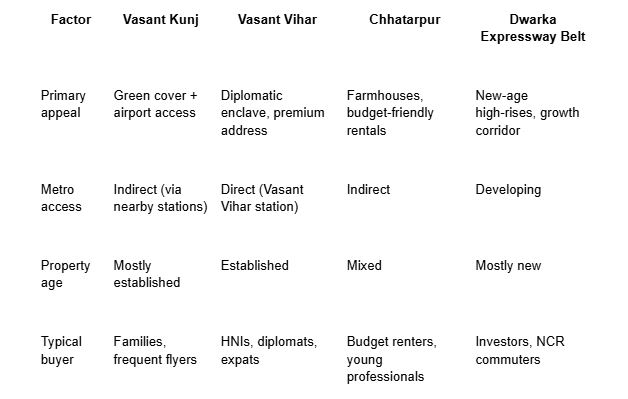
Areas along the growth corridor, such as those offering Premium Homes on Dwarka Expressway, appeal more to buyers prioritising new construction and long-term appreciation, while Vasant Kunj continues to attract those who value an established, green, and centrally located address.
Buyers looking for a stable, established South Delhi address with good resale value often shortlist Vasant Kunj, especially if proximity to schools and hospitals is a priority.
Professionals working near the airport or in Gurugram, along with airline staff, frequently prefer renting here for the shorter commute, even at a premium over outer Delhi rents. Most tenants start their search by asking a local Vasant Kunj rent wala for available sectors and price ranges, since listings can vary a lot between blocks and society types.
Investors typically view Vasant Kunj as a low-volatility, steady-appreciation asset rather than a high-growth bet, given the limited new supply and consistent rental demand.
Visit at different times of day to assess traffic on NH-48 and internal roads.
Check the age and maintenance status of the specific building or society, especially for older DDA flats.
Confirm proximity to your workplace, since commute time varies significantly by sector within Vasant Kunj.
Review society maintenance charges and amenities, particularly for group housing options.
Compare rental or purchase rates across a few sectors before finalising, as prices can differ by 15–20% between blocks.
Confirm distance to nearest school and hospital
Check parking availability in the specific building
Ask about power backup and water supply reliability
Verify society/RWA rules if applicable
Assess resale or rental demand history for that sector.
Given its limited land for new construction, Vasant Kunj is unlikely to see the kind of rapid vertical development seen in newer NCR corridors. Instead, the trend is toward redevelopment of older DDA buildings and steady demand from buyers who prioritise location stability over brand-new inventory. This positions it as a mature, low-risk residential market rather than a high-growth one — a profile that suits long-term residents and conservative investors more than speculative buyers.
Vasant Kunj's continued appeal comes down to a fairly simple combination: planned layouts, green surroundings, strong social infrastructure, and a location that keeps commutes to the airport and Gurugram manageable. It isn't the cheapest option in Delhi NCR, and it doesn't offer the newest inventory, but for buyers and tenants who value stability, established neighbourhoods, and proximity to essential services, it remains one of South Delhi's most dependable residential choices.
Lorem ipsum dolor sit amet, consectetur adipiscing elit, sed do eiusmod tempor incididunt ut labore et dolore magna aliqua.

Sample text. Click to select the Text Element.

Sample text. Click to select the Text Element.

Sample text. Click to select the Text Element.

Sample text. Click to select the Text Element.

Sample text. Click to select the Text Element.
Sample text. Click to select the Text Element.
Sample text. Click to select the Text Element.

Sample text. Click to select the Text Element.

Sample text. Click to select the Text Element.
Yes. Vasant Kunj is considered one of South Delhi's more livable areas due to its green cover, established schools and hospitals, and proximity to the airport and Ring Road.
Not directly. The colony relies on bus routes and cabs to reach the nearest metro stations, such as Vasant Vihar or Chhatarpur, which are a short drive away.
Prices reflect the area's established infrastructure, green surroundings, airport proximity, and limited new supply, all of which keep demand steady even as prices rise.
Yes. The presence of reputed schools, parks, and hospitals within close range makes it a practical choice for families.
Vasant Vihar has direct metro access and a stronger diplomatic-enclave identity, while Vasant Kunj offers more green cover and a wider mix of housing types across a larger area.
Yes, particularly near the Mahipalpur border, where serviced and rental apartments cater to airline staff and short-term professionals.
A mix of DDA flats, independent builder floors, and group housing societies, spread across Sectors A to D, giving buyers and tenants several budget options.
 Location
South Delhi, India
 Hours
Hours
Images from Freepik